

When the temperature hits 30°C, it’s time to break out the shorts and sunglasses. But wait! What does that mean in Fahrenheit? If you’ve ever found yourself scratching your head over the Celsius to Fahrenheit conversion, you’re not alone. It’s a common dilemma that can leave even the most seasoned weather watchers feeling a bit lost.
Understanding Temperature Scales
Temperature scales play a crucial role in daily life, especially when discussing weather conditions. Celsius (°C) and Fahrenheit (°F) serve as the two main scales used around the world. Different regions adopt certain systems based on historical and cultural factors.
Celsius measures temperature based on the freezing and boiling points of water. Specifically, it defines freezing at 0°C and boiling at 100°C. Conversely, Fahrenheit sets the freezing point of water at 32°F and boiling at 212°F. This difference leads to confusion during conversions.
To convert Celsius to Fahrenheit, the formula is (F = C times frac{9}{5} + 32). For example, plugging in 30 leads to calculating (30 times frac{9}{5} + 32), resulting in 86°F. Understanding this formula simplifies the process.
Temperature perception can vary across cultures. Celsius feels more intuitive in countries using the metric system. This system aligns temperature readings with the natural environment. Comparatively, Fahrenheit’s deviations can create difficulties for individuals unfamiliar with its scale.
Knowing both temperature systems benefits those traveling or communicating with people in different regions. It also helps in fields like science, culinary arts, and climate studies. Clarity in communication regarding temperature ensures accurate information exchange across various disciplines.
Grasping the differences between Celsius and Fahrenheit fosters better understanding. Recognizing how people experience these scales may enhance discussions about weather and climate conditions globally. When individuals comprehend this knowledge, it leads to improved practical applications and insights.
Converting Celsius to Fahrenheit
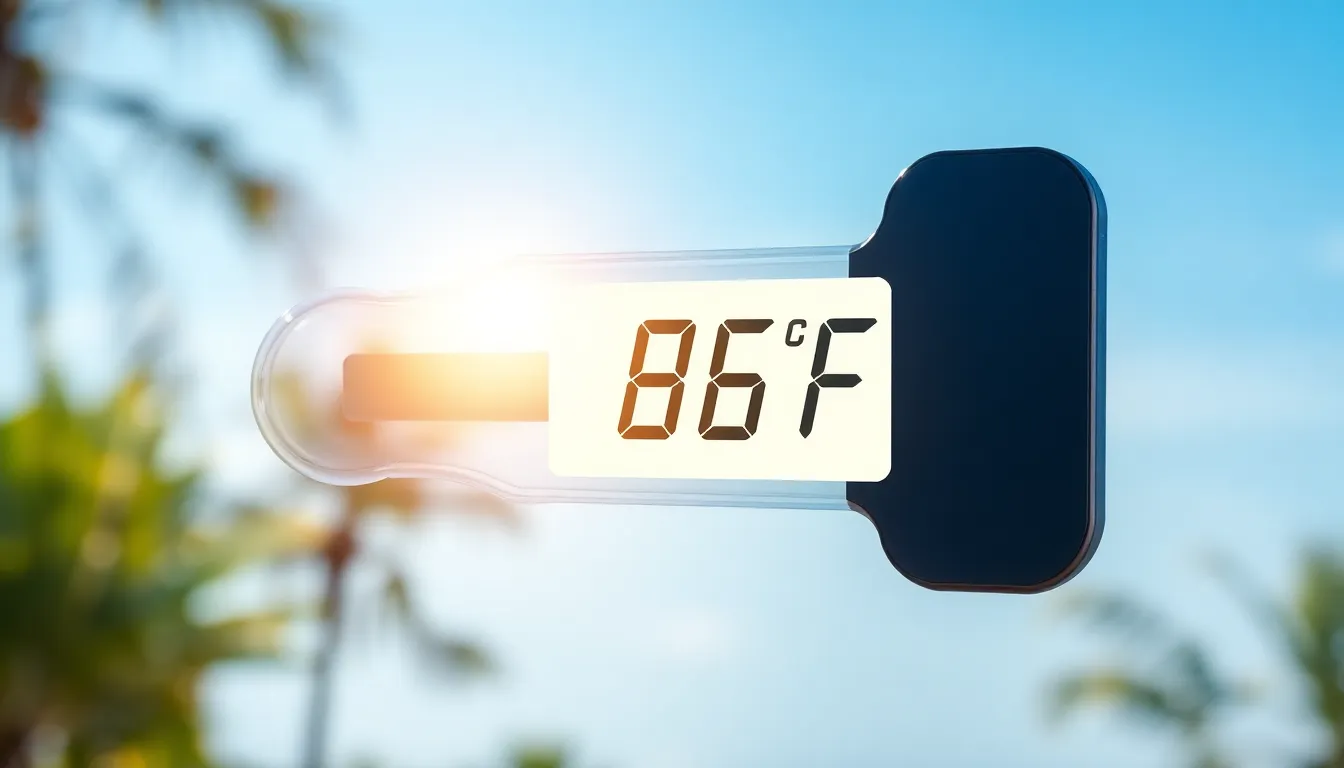
Converting Celsius to Fahrenheit simplifies understanding temperature differences. The formula for such conversion involves two key components: multiplication and addition.
The Formula for Conversion
To convert Celsius to Fahrenheit, use the formula: F = C × 9/5 + 32. In this equation, C represents the degrees in Celsius. Multiplying C by 9/5 adjusts for the scale difference. Adding 32 accounts for the starting point difference between the two systems. This formula allows for precise temperature comparisons. For instance, converting 30°C using the formula results in F = 30 × 9/5 + 32, yielding 86°F.
Step-by-Step Conversion
Begin the conversion by taking the Celsius temperature. Next, multiply it by 9/5. The resulting value then adds 32. For 30°C, step one yields 30 × 9/5, which equals 54. Step two adds 32 to this figure, resulting in 86°F. Following these steps ensures accurate conversions every time. Practicing with various temperatures reinforces the understanding of the Celsius-to-Fahrenheit relationship.
Practical Applications
Understanding temperature conversions has real-world implications. People encounter Celsius and Fahrenheit frequently in everyday situations.
Everyday Temperature Contexts
30°C translates to 86°F, a familiar temperature for summer activities, especially in regions like the United States. Many individuals assess weather reports in Fahrenheit, but travelers in Celsius-dominant countries may need to convert for comfort. Comfortable room temperatures often hover around 20-22°C (68-72°F), whereas 30°C indicates a warm day, prompting considerations for clothing and hydration. In cooking, recipes using Celsius often require conversion for accurate temperature management, ensuring safety and quality in culinary results.
Importance in Science and Industry
Temperature scales play a crucial role in scientific experiments. Most scientific communities prefer Celsius for precision in measurements. Engineering applications also rely on accurate temperature readings, especially when assessing material properties. HVAC systems benefit from clear temperature communication, optimizing performance based on Celsius and Fahrenheit conversions. Climate research embraces both scales, facilitating global discussions on climate change. Accurate conversions support effective data analysis and inform strategies for sustainable practices.
Common Misconceptions
Many individuals mistakenly believe that a simple change in the number means a corresponding change in comfort levels. People often think 30°C feels much milder or harsher depending on their familiarity with Celsius. Misinterpretation occurs when individuals underestimate the significance of converting to Fahrenheit.
A common error includes assuming that 30°C equates to direct numbers in Fahrenheit without applying the proper formula. Some may think memorizing a few conversion points suffices, ignoring the need for precision when discussing temperature in various contexts. Taking into account that Celsius and Fahrenheit represent different temperature scales helps clarify many confusions.
Often, individuals equate Celsius directly to Fahrenheit at specific intervals. For instance, they might believe that 30°C must always feel the same across different geographical areas. Real-life experiences can vary significantly, especially when humidity and climate play crucial roles in temperature perception. This misunderstanding hampers effective communication, especially in travel-related discussions or culinary practices.
Conversely, some people overlook the practical use of temperature systems in daily activities. Comfort levels at 30°C (86°F) can dramatically differ based on the environment and individual preferences. Remaining aware of cultural differences and context enhances understanding.
Individuals might also think that scientific applications prioritize one temperature scale over the other without realizing both scales have specific applications. For precision in scientific research, Celsius remains a standard, while Fahrenheit often pertains to everyday life in the United States. Thus, recognizing these distinctions fosters better discussions surrounding weather, cooking, and climate change.
Understanding the conversion from Celsius to Fahrenheit is essential for effective communication in various contexts. With 30°C equating to 86°F, grasping this relationship helps individuals navigate weather reports, cooking temperatures, and climate discussions more confidently.
Recognizing the differences between these temperature scales enhances everyday experiences and fosters clearer conversations, especially in environments where both systems coexist. By mastering the conversion formula and acknowledging the cultural nuances of temperature perception, individuals can improve their practical applications in daily life. This knowledge not only aids in personal comfort but also contributes to informed discussions about climate change and scientific research.


